Semantic search across people, skills, departments and roles. Inferred similarity finds candidates that match without keyword matches. Subgraph traversal surfaces ex-colleagues, internal-mobility paths and skill concentration risks.
Every candidate, employee, skill, department and role becomes a node. Edges capture explicit relationships (has_skill, works_with, reports_to, mentors, interviewed_for) and inferred ones (similarity > 0.75 via vector embeddings). Ask in natural language and the graph answers — with the people behind it.
"Find a PM who's worked in fintech" matches on meaning, not keywords. Three-tier search: vector embeddings → AI-assisted SQL + graph expansion → keyword fallback.
Vector cosine ≥ 0.75 surfaces candidates similar to your top performer — even when their resumes use completely different language. Find the next 10 like the best one you already hired.
N-hop subgraph traversal reveals candidates who worked with your existing employees, who report to whom, who mentored whom. Reference checks built into the graph.
Open a role and the graph surfaces employees in adjacent skill clusters who could grow into it — promotion candidates you'd otherwise miss.
See where critical skills cluster on a single person. Bus-factor visualization for your engineering, sales and ops orgs — before someone gives notice.
Surveys, interviews, simulations, performance reviews — every signal becomes an edge or a node attribute. The graph compounds value with every interaction.
"Senior backend engineer with payments experience and someone who's worked with our Lead Engineer." The graph parses intent, finds nodes, expands relationships.
Top 20 nodes with similarity scores. Click any result to see the graph path — which skills matched, which colleagues overlap, which projects connect.
Open the network view. Pan, zoom, expand N-hop neighborhoods. See your team's skill topology at a glance.
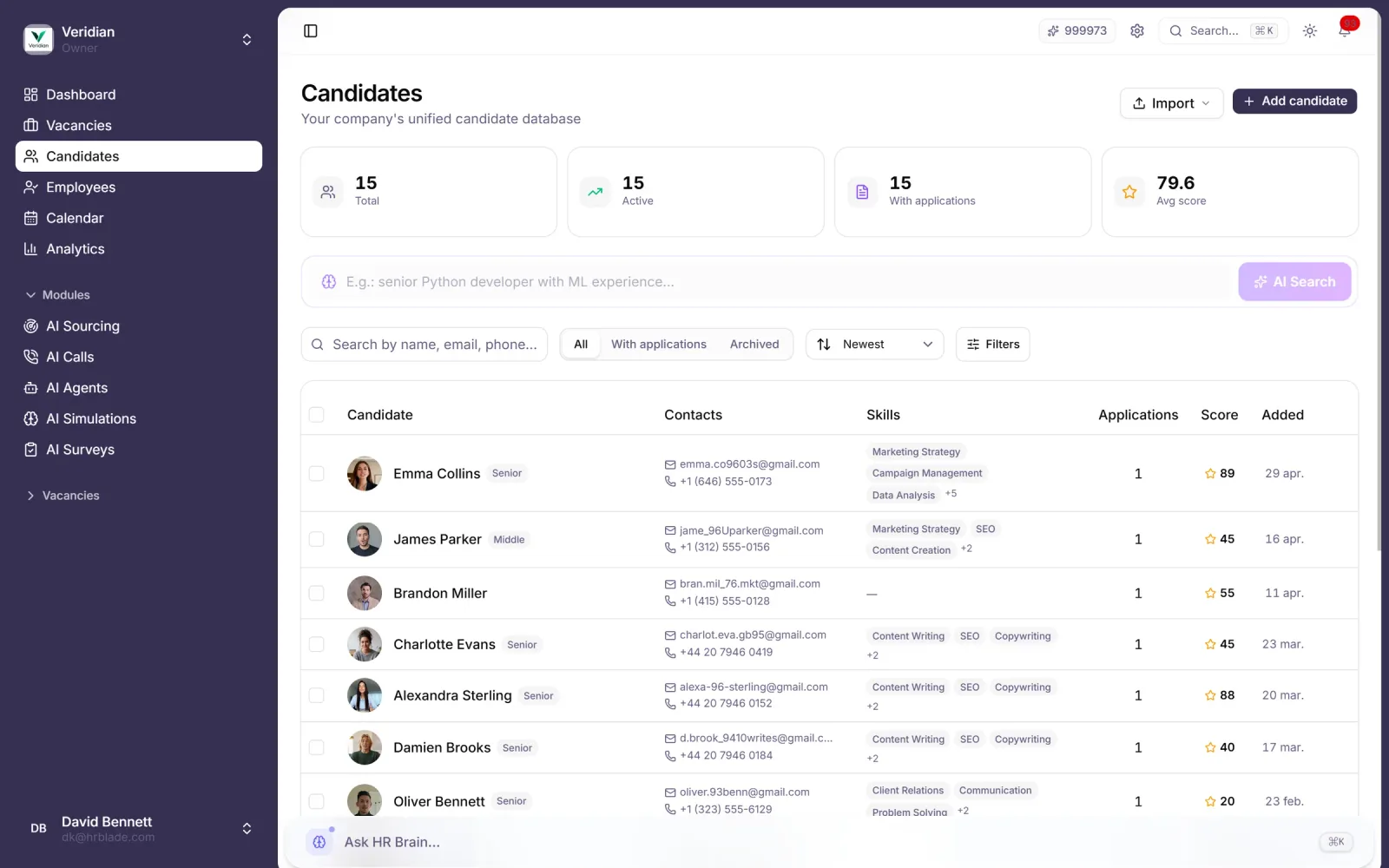
Source: HRBlade TalentGraph spec
Source: HRBlade TalentSearchService
Source: HRBlade product
Pick your best engineer. The graph returns the 20 most-similar candidates in your database — not by job title, but by behavioral and skill similarity.
Filter for candidates who've worked with at least one current employee. Built-in social proof and reference paths.
Visualize your team's skill graph. Find the gaps before you write the next job spec.
Automatically from your existing data — candidates, employees, applications, interviews, surveys, assessments. Vector embeddings are generated asynchronously and refresh as new data arrives.
Autonomous AI agent with 17 hiring intents. Semantic candidate search across your database in 2 seconds.
Multi-agent AI simulates real team dynamics — before you hire, promote, or reorganize.
30+ connectors: LinkedIn, GitHub, Stack Overflow, Indeed, Apollo, Hunter and more. Auto-deduplication.
The information on this website is provided for general information only and does not constitute an offer or a binding commitment. The binding agreement is the Terms of Use at workspace.hrblade.com/terms; where anything on this site is inconsistent with them, those Terms prevail. Product features, availability and figures shown here may change without notice.